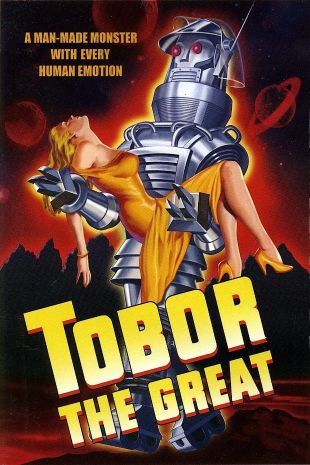
(1954)2Bruce EderTobor The Great is not a bad idea for a movie, though surprisingly enough it is executed badly by a director from whom one might have expected more -- Lee Sholem (aka "Roll 'em Sholem") was an action movie specialist, an expert at bringing low-rent (but nonetheless bracing) thrills to the screen, large or small, on time and under budget. The movie, about the "friendship" that develops between a clever young boy (Billy Chapin) and a seven-foot-tall experimental robot (played, uncredited, by Lew Smith), is one of a large handful of 1950's science-fiction stories built around children; it isn't the lowest budget of them (that dubious distinction belongs to Phil Tucker's Robot Monster), nor the most prestigious (Invaders From Mars, The Invisible Boy), standing somewhere in the middle. The boy-and-robot story has its emotional tugs (the boy is brilliant, and his father was killed in the Korean War), and also its unintentionally bizarre elements (his mother, played by Karin Booth, wanders through the proceedings like a Stepford Wife, oblivious to the scientific wonders around her but definitely worried about keeping house). The villains include the usual Iron Curtain suspects and stooges, including Steven Geray, Peter Brocco, Hal Baylor, and Henry Kulky; the latter does a bit that must've recalled his days as a wrestler, and is especially funny mixing it up with the robot. And for a hero, we have Charles Drake, sounding and looking tough as a two-fisted scientist (in all of these kinds of movies, the scientists on our side are tough guys at heart). Also on hand is veteran character actor Taylor Holmes, in what may have been the only full-flesged starring role of his career, as the boy's genial scientist/grandfather. And with all of that to work with, Sholem lets us down exactly where he shouldn't, in the scenes depicting the robot's abilities, and the action sequences -- perhaps there wasn't time for re-takes, or to devote much attention to pacing (one suspects this was actually a busted TV pilot, turned into a movie), but why does the scene with the reporters and the robot play so slowly and so flat? And how could Sholem, who handled more than his share of episodes of the first season of The Adventures of Superman, miss the opportunity for some close-ups and tight shots when Tobor goes into action, whether it's wrecking a house or rescuing the victims of a kidnapping? These are exactly the scenes that one would have expected Sholem to handle to perfection, and they're where the movie loses speed and energy. The film still has some appeal, from the basic concept of the plot, and that cast, plus the action that is there, but it ends up being more an assembly of scenes with a lot of potential than a diverting science fiction entertainment. Or, at least, that was how it seemed for the first couple of decades after its release. The passage of time has imbued it with some added nostalgia appeal, owing to its period detail and sensibilities, and its also surprising prescience in suggesting the establishment of a NASA-like civilian space agency, four years before such an agency was created by President Eisenhower. Any way one takes it, the movie is worth a look, as long as one doesn't expect too much. (And the presence of perennial science fiction supporting player William Schallert in a small role only adds to its cult appeal for movie buffs).
This children's sci-fi adventure chronicles the friendship between an 11-year-old and his grandfather's robot Tobor, who was designed to explore deep space. Tobor, unlike other machines, was endowed with human emotions. Trouble erupts when the communists kidnap him and try to make him do their evil bidding. Fortunately, Tobor is mind-linked to his creator and cannot be easily reprogrammed. The adventure begins when the boy and the scientists attempt to save the robot.