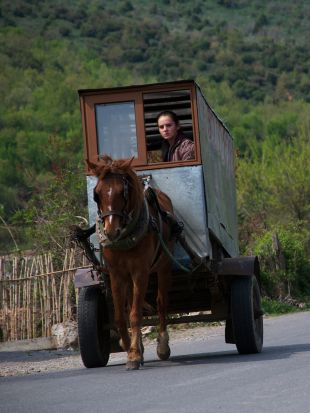
(2011)4Nathan SouthernWriter/director Joshua Marston's second feature, The Forgiveness of Blood, pulls us into contemporary Albania, and observes the eruption and trajectory of an ugly local phenomenon known as a "blood feud," as it threatens to rip apart one particular family. The event starts in the most banal and unassuming of ways: the patriarch, Mark (Refet Abazi) gets into a seemingly minor quarrel with a hotheaded neighbor, Sokol (Veton Osmani), over the right to cross the fellow's land in his horse-drawn wagon. Though Mark withdraws from the premises when Sokol threatens him with an enormous blade, he later returns with his brother and reignites the argument, leading to Sokol's death. Mark manages to evade the authorities for a time, but rage overtakes Sokol's clan, and they publicly vow to kill not just the presumed murderer, but any members of Mark's family. The family soon finds itself buckling beneath the constant threat of violence, especially when a sniper begins firing rounds of ammunition into the home. In response, the residents fortify the house, turning it into a brick-walled stronghold. Most dramatically impacted is son Nik (Tristan Halilaj), a teenager who longs to experience normal adolescent life, especially a blossoming crush on Bardha (Zana Hasaj), a pretty girl in his class.
The picture's central narrative arc involves Nik's maturation into adulthood and headstrong push for independence. A brief summary of this might make it sound straightforward, though the opposite is true. Nik's final actions in response to the family are as complex and ethically and tonally murky as they are definitive, and seem to emerge both because of and despite the restrictions imposed on the clan. As a result, we are never sure how to read this character, and his impulsive behavior imparts an added layer of complexity. Marston, for example, includes a wonderful scene where Nik hacks up a bedroom wall with a knife, seemingly without purpose; we can read the emotions as misguided anger, even if we are never sure where those emotions will drive him.
If Marston limited his scope to Nik's story, the material would qualify as a great and well-observed drama, yet the picture as a whole is even more narratively complex than this. Using the family's plight as a fixed element, Marston begins to look at how the feud has impacted various secondary characters and therefore fractures his story into numerous strands. It all adds up to a sweeping, ambitious, and highly singular picture of early 21st century Albanian rural life. On this note, Marston's film may be slyest for its refusal to explain any of the fundamental elements of Albanian society, such as the kanun (rules of code to govern local behavior), the besa (a brief amnesty issued by the party that declares war on another), or even -- on a broader and more sweeping level -- the fierce, obstreperous familial loyalties that linger in the community, omnipresent in every citizen's actions and statements. Marston takes a huge gamble by assuming that unfamiliar viewers will latch on to the basics by virtue of context; this is a risk that pays off, as we never once feel lost or confused. Marston also takes a leap of faith with his onscreen pace. From the beginning -- a signature image of a village resident moving rocks to facilitate a neighbor's use of his land -- the narrative moves at a slow, measured crawl that recalls the work of Bela Tarr in its ability to pull viewers into the languorous rhythms of these characters and the world they inhabit.
As this assessment suggests, The Forgiveness of Blood succeeds almost entirely on its own terms, which is particularly remarkable given the overwhelming challenges that Marston faced in making it. This picture was the product of an American director who decided to create a drama about Albanian culture, shot in the local language with nonprofessional actors, and backed by European money. It might be unthinkable if the writer/director hadn't already pulled off the same feat once before to widespread acclaim (his 2004 debut, Maria Full of Grace). Forgiveness confirms Marston as much more than a one-hit wonder, demonstrating, as Maria did, his gifts with narrative, characterization, and dialogue, as well as his preternatural instinct for picking up on acute cultural nuances that would elude most non-native filmmakers.
A young man faces a life paying for the misdeeds of his elders in this drama. Nik (Tristan Halilaj) is a teenager growing up in a small village in Albania; he has little interest in his father's baking business, and is more concerned with surfing the Internet, hanging out with his friends and trying to impress Bardha (Zana Hasaj), a pretty girl he knows from school. But whatever future Nik might hope for is put on hold when his father Mark (Refet Abazi) revives a long-standing feud over a land dispute with his neighbor Sokol (Veton Osmani), leading to a violent confrontation that claims Sokol's life. An ancient Albanian tradition has it that the survivors of a violent murder can kill a man from the family that committed the crime without consequence; however, they can only do so in the open, so Nik and the other men in his household are only safe as long as they stay in their home. As Nik's sister Rudina (Sindi Lacej) takes over the family business, his world is reduced to the inside of the family residence, which proves to be almost as maddening as the possibility of being murdered. American filmmaker Joshua Marston shot The Forgiveness Of Blood on location in Albania using a cast of local actors; the film was an official selection at the 2011 Toronto International Film Festival.