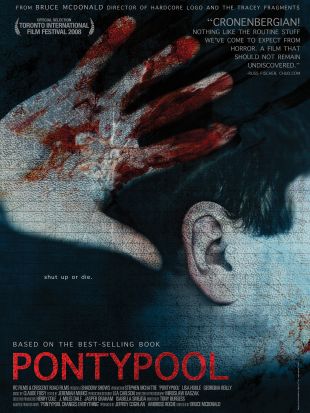
(2008)4Jason BuchananIn the apocalypse of words, the last thing you want to be is a radio DJ. The world collapses on an intimate scale in Pontypool, a hyper-linguistic thriller that's expertly acted and refreshingly minimalist. Set in a small-town radio station, Pontypool features three primary players: a producer, an engineer, and a DJ. Something is happening just outside the station, but it's not clear what. Telephone reports of people attacking others in mobs and speaking nonsense are flooding in, and a rogue French broadcast recommends avoiding terms of endearment due to fears of a vocal virus.
The narrative largely unfolds around Grant Mazzy (Stephen McHattie), a down-and-out DJ who, having been relegated to working in Pontypool after losing his gig in the city, is looking to shake things up behind the mic. One day, engineer Laurel Ann (Georgina Reilly) hears a report about an unusual hostage situation on the local police scanner. Though producer Sydney Briar (Lisa Houle) is reluctant to report on the unconfirmed incident over the air, Grant presents the story as breaking news and, before long, additional reports of a riot at a local doctor's office paint an ominous picture: people are dying and a convoy of military vehicles, accompanied by helicopters, has been spotted just five kilometers from the radio station. Incredibly, there's nothing on the wires about the situation, and neither Sydney nor Laurel Ann can get any kind of confirmation. Later, a report from a local constable reveals that the crowds are chanting unintelligible babble as they attack, and others describe a "herd" of people at the edge of a forest, and a "mountain" of people who have trapped a family in a car. When a BBC reporter calls to confirm that French-Canadian soldiers are setting up roadblocks to prevent anyone from leaving or arriving in the area, Grant, Sydney, and Laurel Ann's worst fears are confirmed.
It's hard enough to maintain tension with a multi-million-dollar budget and an Oscar-caliber cast. Director Bruce McDonald and author/screenwriter Tony Burgess make it look easy with nothing but a cramped radio station and a handful of damn good actors. It's always fun to see old ideas presented in new ways, and that's exactly what McDonald and Burgess accomplish here. The disaster they depict is brilliantly conceived, and beautifully executed. Every moment of psychological disorientation has been expertly orchestrated down to the letter (or, perhaps more appropriately, the syllable). And with actors like Stephen McHattie delivering those carefully scripted lines, they carry real weight. Were Pontypool performed as a radio play instead of a motion picture, this atmospheric, three-person set piece could have been a worthy successor to Orson Welles' "War of the Worlds" -- mostly thanks to McHattie's golden throat and a masterfully timed series of increasingly unsettling events. Just as if we were listening to an actual radio program during a disaster, we remain absolutely riveted as callers phone in to offer vivid firsthand accounts of the horrors unfolding just beyond our field of vision.
Critics often claim that movies that leave something to the imagination have a far greater impact on viewers than the movies that reveal too much. If any movie could make the case for this position, it's Pontypool. By presenting the story through the words and voices of terrified callers, McDonald and Burgess create a truly nightmarish scenario. This is the less-is-more approach, though McDonald doesn't sacrifice style for substance as his camera nervously glides through the studio, continually settling on close-ups of Grant's, Sydney's, and Laural Ann's disturbed reactions. McDonald knows that if a movie is going to play out largely in two tiny connected rooms, he needs to keep things visually stimulating, and Pontypool is gorgeously shot for maximum claustrophobic impact. Recurring shots of the audio waves add an eerie touch to the proceedings, and while we can't actually see what's happening outside the studio, we can certainly feel it. It's human nature to fear the unknown, and it's precisely McDonald and Burgess' willingness to embrace that big, scary unknown that makes Pontypool one of the most invigorating, original horror films of the decade.
Bruce McDonald, critically acclaimed director of The Tracey Fragments, teams with author Tony Burgess to adapt Burgess' own novel about a small town in the grip of a mysterious frenzy. It may be Valentine's Day, but for caustic radio personality Grant Mazzy (Stephen McHattie) that's just another reason to be miserable. Mazzy used to be a certified radio superstar, but working in Pontypool is a far shot from working in the big city. Today, however, as Mazzy prepares for his regular routine of reading the weather, updating school closings, and pleading his case for a little on-air controversy to producer Sydney Bryer (Lisa Houle), the appearance of an unexpected figure signals the beginning of a disturbing phenomenon in the small town of Pontypool. Heading to work, Mazzy is nearly run over by a distraught woman who seems to have lost her grip on reality. Later, reports of a shoot-out between provincial police and a group of local ice fishers are made even more bizarre by the revelation that they were all screaming gibberish, running around nude, and missing body parts. By the time a riot breaks out in Dr. Mendez's (Hrant Alianak) office, it's obvious to Mazzy that the residents of Pontypool are suffering from a strange form of contagious dementia, but what has caused this bizarre outbreak and, more importantly, how can it be stopped?